
Being at Home in Your Body, Laughing

One moment during a yoga workshop, my teacher said, “Buddha is laughing because there’s nowhere to go.” I don’t remember the context of this proclamation. Were we practicing asana? Was it a dharma talk? Was this in her answer to a student’s inquiry? I have no idea. But this quote is now handwritten, in cursive, on a piece of paper I have placed in the back of my bathroom cabinet. I see it multiple times a day.

Laughing feels like bubbles. And it’s one of the features of my Inner Sanctuary.

When I teach my preschool, kindergarten, elementary, middle, and high school students whole-being-resilience, I often begin by helping them create a happy place. There are lots of names for this whole-being-restorative mind-body practice: Safe Space, Inner Resource, Inner Sanctuary. Most students stick with the classic: Happy Place.

I explain why I’m spending our precious time on this practice. This explanation is essential: to create sensations of peace, safety, and security in their body no matter where in the world they happen to be, or where in the universe (or multiverse) they end up. This way, they will always have access to their prefrontal cortex and abide in thriving mode rather than survival mode. Because of this they will not be controlled by their thoughts, emotions, or fear-based reactions. They will be able to step into freedom, making wise choices about what to think, say, and do – as well as what not to think, say or do – in any given moment. It is also to create consistent and ongoing opportunities for their nervous system to rest, repair, and renew itself. Repetition will then create greater ease of access to this space in the future thanks to neuroplasticity, neurogenesis, and synaptic strengthening. The main reason they are willing to experiment, however, is because I also explain that it feels like sleep, and is often much better than sleep, to be honest.

Photo by Enric Cruz Lu00f3pez on Pexels.com

There are many ways to practice creating and being in your inner sanctuary. One way I guide practice is by inviting students to rest back in their chair or forward onto the table, eyes open or closed, notice the places their body makes contact with what’s beneath it, and allow the breath to come and go. Then I lead them through their five senses and invite them to use their imagination to create the safest, coziest, most favorite place they can in as much detail as humanly possible. They choose all the locations, structures, landscapes, shapes, lines, colors, textures, sounds, scents, and flavors that make them feel safe, cozy, and happy. Anything and everything about their happy place can be real or imagined, true or fantasy, from the past, present, future, or all of the above. They can invite images of people they see everyday who make them feel safe, as well as spiritual beings, ancestors, or animals into their happy place. They can also choose to be sweetly, beautifully alone.

Photo by Pavel Danilyuk on Pexels.com

Before we begin, I explain that it’s okay if they can’t think of anything at first, if their mind is blank. It’s also okay if the images change during the practice. And they don’t even have to do the practice themselves; they can just listen and observe. Lastly, they can always come out of the practice at any time.

Happy Places change as we change. They never have to stay the same unless we want them to. To offer an example from my own life, I share that one of the fixtures of my inner resource is the sound of my children GIGGLING. When they were younger (and I was younger), it was
the sensation and scent
of their little bodies
sleeping against mine.
But now it is the giggling
rupture-ous kind of laughter,
the kind that spills
up and out
fountain-ous
upside down
sideways
waterfalls.

Photo by Oliver Sju00f6stru00f6m on Pexels.com

Buddha laughing because there’s nowhere to go is one of the most precious permission structures I’ve ever encountered. I love it: Do nothing. Go nowhere. Are you imagining this?
Stop striving.
Rest where you are.
Be at ease.
Be peace.

The Happy-Place-Inner-Sanctuary-Safe-Space-Inner-Resource practice is like this:
Here you are.
You have already arrived.
Abide in peacefulness.
Abide as Peace.


I also introduce my school-aged students to the concept of dignity, being worthy of love and respect simply because we are alive, alive in these bodies! There is sacredness to us. We are sacred. That’s it. There’s nothing to earn or prove. There is nowhere to go. We are the proof of our own worthiness. We are our own evidence of pricelessness. All of us can stop everything we’re doing and be breathed by the animating force within all things.

Photo by James Wheeler on Pexels.com

My meditation teachers sometimes invite us to sit with a tall spine, to extend through the back of the skull and crown of the head, dipping the chin just an inch. A posture of inherent dignity. This is one way of honoring our sacredness. My other meditation teachers invite us to lie down, reclined and bolstered by cushions, pillows, blankets, and weighted sand bags shaped like hearts. A posture of inherent royalty. This is another way of honoring our preciousness.

Photo by Hiu1ebfu Hou00e0ng on Pexels.com

I invite my students into these spaces of dignity, self-love, safety, comfort, and security. I give them space to decline. I smile when they appear shocked that I am allowing them sleep during class. “If your body falls asleep, no worries, I’ll wake you up when it’s time.” I laugh when they open their eyes and say, “Yeah, I’d do that again.” I thrill when they tell me the next day they used their Happy Place Imagination Practice to fall asleep – and it worked.


Buddha’s laughter reminds me to keep practicing levity.

I used to be SUPER serious All The Time. (Some people don’t believe me when I share that fact.) So much so that I’ve been working on laughter as a spiritual practice for YEARS. One day a while back the universe gifted me with someone who is good at this laughing-in-the-face-of-difficulty-thing. Then the universe gave me ANOTHER someone who is also good at this laughter! I continue to learn from them daily.

One of the things that makes me laugh the most is my children’s laughter. When they belly-laugh and can’t breathe in and their faces turn red, or contort, or expand in utter surprise at the unbelievable ridiculousness of a situation, I just can’t get enough. And I love it when this happens to me. I love it when I think something is so funny that I can’t tell the story because I’m literally crying-laughing. Sometimes I can’t finish telling the story, and sometimes I can’t even start telling the story. The words won’t come out and every time I even think about it I burst out laughing. I love this so much. But I can’t create it, as much as I try, I cannot create this experience. It is a sheer gift. But I’m going to keep trying. I’m going to keep taking myself less seriously. I’m going to shift my perspectives. I’m going to turn myself upside down and create opportunities for laughter to bubble up from the depths of me – you know, where all the joy lives 😉

Photo by Loren Castillo on Pexels.com

Laughing is the epitome of homecoming. When we are belly-laughing we are in the moment in our bodies and it feels good to be there.

I was going to say that when we’re laughing we are the least self-conscious we ever are, but that is definitely not true for a lot of us adult women. A ton of us end up covering our mouth or our face to hide the contortions, stifle the sound of our giggle, cross our legs and hobble to the bathroom to pee, or all of those. And some of us don’t. I’ve been letting myself laugh in whatever ways that laughter wants to come out, and that feels magical. There are many, many reasons laughter is considered the best medicine. There’s tons of research proving that now, but I don’t need any more proof than my own direct experience.

Try it out:

  • Create Your Happy Place
  • Fill it with Laughter
  • Experience it
  • Notice How Your Body Feels
  • Repeat Daily

Being at home in your body doesn’t mean you have to love everything about it, or love everything it is or everything it isn’t. Being at home in your body simply means you feel safe there. You know how to care for it. You allow it to live and move and have its being. You feel like your body takes care of you and you take care of it to the best of your abilities. It means you forgive your body like you forgive the most dear, sweet little child. It means that you don’t even have to considering forgiving because your body has done nothing it needs forgiveness for. Being at home in your body means you listen to it like an elder, you sit at its feet and honor its ancestral wisdom. Being at home in your body means you are comfortable there, for the most part, not every second of every day, but you can find a way to drop into easiness. It’s worth the effort and it’s worth the practice and it’s worth the curiosity and it’s worth the love and it’s worth the work.

It doesn’t feel good to be uncomfortable in my own skin, to feel trapped in my own body. It doesn’t feel good to compare myself to others and wish I was them. It doesn’t feel good to be a puppy and wish I was a polar bear.

Realizing that there is nowhere to go means we understand that all we need is within us. Here. Abiding in our true nature. We wait. We allow ourselves to be moved. To be breathed. And then we open the portal to all the wisdom of the cosmos. She comes to us in the great silence, bubbles up from the never ending well of sweetness and is sooooooooo generous.

Being at home in your body is the most beautiful, precious, priceless gift you can give yourself. And really, no one can give you this gift but YOU.

XOXOX,

A.
The “It’s Been Awhile Newsletter” (Such a Classic): and a new-ish piece about violence

Hello, Dear Reader, Lover of Yoga, Poetry, Writers, and (maybe) Music too(?),

Thank you for opening this post. I love you.

(New-ish piece is below if you wanna just scroll there.)

So, yeah, it’s been a while and this is a classic headline for me — and many other people scattered about the world. I know, because I subscribe. (Little side-smile with eye-twinkle.)

I have made a monumental decision:

Are you ready for it?

I’m going to write Like MySelf.

Yep. That’s it. I’m gonna write like myself.

Years ago, in college, I took a nonfiction writing course. I can’t remember the actual title, but there was a lot of memoir-work. My final portfolio project was a collection of bits and pieces of my life, kinda like a collage-mosaic in a binder. I was born in 1978, so I was taking this class when email had just been released to the general population and websites were experimenting with what it meant “to be a web.” Not kidding: my dear computer-lab-writing-center-director was COMPLETELY JAZZED about the possibilities of the interconnectedness of information. She was GENUINELY THRILLED about something she was calling a “hyper-link.” Her enthusiasm was contagious even if confusing.

Anyway, at the end of this nonfiction writing course, I turned in a binder that held some of the most precious moments of my 20 years. It was received with tenderness, but was returned with notes about how this structure just wasn’t going to work. It just wasn’t right. It just wasn’t what it needed to be. It wasn’t cohesive (or something). I was so struck by this feedback that to this day I can’t even remember what I had titled it. I blocked it out. I think I even threw it out in one of my “fits of cleaning.” I only remember one word: Snippets. I just wanted to share snippets of my life, like some kind of scrapbook that only had words inside. I thought this course was a creative nonfiction writing course. Was it? I can’t remember. And isn’t memoir-writing creative? I mean, come on – we all know that when we write our life experience we live twice. We all know that in the writing we are creating. Why wasn’t I allowed to offer unstructured “snippets” of my life. Who’s keeping these gates?

Well, I’m opening them now.

Okay, so, that’s one announcement: I’m going to write like myself. I’m going to post snippets. I’m going to use all the genres if I want and I might make up new ones and I might opt out of using commas (see this sentence). I’m going to use the word “just” as many times as I feel appropriate (just please see above). I’m going to make references and probably not “hyperlink” them to anything so that you can focus on just one thing. AND, I’m going to use repetitive sentence structure if it’s effective, and I want to.

Thank you for indulging me in this adventure of being myself.

Second announcement: I’m going to try to actively grow my readership on Substack. Please subscribe: @amysecrist on Substack.

Third announcement: I’m going to finish writing my books. Some of them are in a word document; some of them are in my mind; some of them are in the archives; some of them are in my body-mind; some of them are in my heart-mind-body-mind; some of them have working titles: Curiosity & Kindness: The Way We BE Together; Magnolia Meditations: 30 Poem-Prompts for Your Inspiration.

Okay. I think that’s it for this moment.

I started the piece below two years ago. I don’t know what happened. (I have about 84 different drafts in my drafts folder.) I got distracted. I abandoned it. It abandoned me. Or maybe more truthfully, we got separated. Please enjoy.


The Violence of Expectations

Storied, admired, and celebrated Montessori preschool teacher, whom I met in the final two years of her long tenure, gave me advice after a conference for our oldest child, our oldest son:  Be tender.  That stuff about tough love?  Don’t buy it. 

This was after she told us, He’s already got his perfectionism issues. Don’t add to them.  

And this:  Don’t believe what they tell you about being firm and strict and exacting with your discipline.  It’s love, it’s all love. 

She had become a grandmother by this point, and would share stories of her experiences with her young granddaughters, all they were teaching her.

All they were teaching her.

I’m working at that school now, teaching even the youngest students a little bit about neuroscience and the power they have to change how they feel, the freedom that exists in their breath when they choose the way they will exhale: like a lion, an owl, like someone blowing bubbles or cooling off hot chocolate.

I didn’t know much, if anything, about resilience when my boy was in preschool, but the head teacher’s comments changed the way I approached him. I became a little softer, more patient, more observant, and better able to absorb the wisdom emanating from his innocence. He’s now entering his senior year at university, and I’ve taught him everything I knew at every moment the opportunity presented itself throughout his busy and chaotic adolescent years. When I learned it, I shared it. We currently discuss books and songs about spiritual philosophies. We send each other links to interesting teachings and satirical commentaries, and continue to encourage each other to remember our keys, cards, travel mugs, and important papers because we are more likely to be celebrating the effects of some gorgeous solfeggio frequency than checking our “notes app to-do list.”

Needless to say, the two of us help each other and one of his younger sisters navigate balancing our experience of having our heads in the clouds and our feet on the ground. There’s so much to “get done” in this world, in this life, and the three of us are quite enthralled with how we all feel about it rather than what it takes to complete it. We are practicing, and progressing, getting better at checking our lists and gathering our supplies. We are becoming ourselves.

It wasn’t always this way for me, this way of “practicing” and “becoming.” I have spent my entire conscious life navigating around, wrestling with, and understanding my relationship to society’s expectations, specifically Mid-West-American-Christian society’s expectations of me as a middle-class-cisgender-heteronormative-white-woman who was born in 1978, and the way I interpreted them: Do every thing you can for every one else all the time while doing everything for yourself by yourself because “you don’t need anyone and are completely self-sufficient,” while also producing goods and services for the community as efficiently as possible, while at the same time growing human beings in your body, one after another, while always smiling and keeping a pristine home, fulfilling spiritual and corporal works of mercy, volunteering and contributing to any and all manner of activism movements to support people who are oppressed and marginalized, including the environment, while being in peak physical condition, and while meeting all standards of beauty and attractiveness At All Times because “it’s (technically?) possible” to do so. I’m not saying that any one person or any one group taught me these things. I’m acknowledging that this is what I inhaled growing up – it was in the atmosphere, and the atmosphere is layered.

In Conjectures of a Guilty Bystander, Thomas Merton writes:

“There is a pervasive form of modern violence to which the idealist…most easily succumbs: activism and over-work. The rush and pressure of modern life are a form, perhaps the most common form, of its innate violence.

To allow oneself to be carried away by a multitude of conflicting concerns, to surrender to too many demands, to commit oneself to too many projects, to want to help everyone in everything is to succumb to violence.

The frenzy of the activist neutralizes [their] work… It destroys the fruitfulness of [their]…work, because it kills the root of inner wisdom which makes work fruitful.”

When I first encountered this understanding of the violence of modernity, my brain immediately processed it and applied it to the torrent of expectations I was experiencing, all day every day, all of society’s and all of the internalized expectations I thought were mine. I finally began to understand that I am able to create expectations for myself. Ones that are in alignment with reality. So that’s what I do now. I get in touch with reality. To the best of my ability. I vet my sources. I make decisions. I create space to choose. As best I can.

My son’s preschool teacher came to the senior violin recital he performed at his highschool graduation party 4 years ago. I told her I loved her. She expressed her happiness for my son, her student. I am no longer exacting in my parenting. I gave that up about 17 years ago, so his three younger siblings have benefitted greatly. And I teach my preschool, elementary, middle, and high school students about the terror of perfectionism and the cruelty of the self-improvement cycle. We play around with compassion and with wisdom, two wings of the bird of peace.

Don’t worry or be too impressed or too hard on yourself – I still wrestle, but gently now, you know, because, my joints. They hurt.

I love you. Thank you for reading.

xoxo,

A.

Wired to Connect: An Introduction to Interpersonal Neurobiology & Why It Matters

This article defines the terms Interpersonal & Neurobiology to better understand how building relationships in the classroom, and in our personal lives, can have a profoundly positive impact not only on learning and job satisfaction, but on all of our social experiences. There’s even a bonus section on mirror neurons followed by takeaways and games to help you practice growing positive relationships.

Interpersonal Neurobiology

Interpersonal Neurobiology (IPNB) is both the well-spring and the continued blossoming of social-emotional learning (SEL) and relationships. It is the study of how the body & brain (central nervous system), the mind (perceptions, thoughts, and cognitive processing), and relationships influence our well-being (our felt sense of ease and joy).

Dr. Dan Siegel is the pioneer of IPNB, and describes it as an interdisciplinary approach to human health combining all branches of science into one perspective. He describes the term interpersonal as what’s occurring both between individual people and within each individual person. Dr. Siegel goes on to explain that “Inter” refers to the “between-ness” of our interactions with others, and “personal” refers to the “within-ness” of our own subjective experience – basically, all the things going on inside us like thoughts, body sensations, and emotions. We can think of the term interpersonal as “between us and within us.”

Neurobiology

Neurobiology is the study of our nervous system and how it functions. The autonomic nervous system (ANS) is made up of the brain and spinal cord (Central ANS), and the system of nerves that extend from the Central ANS throughout the entire body (Peripheral ANS). Both stress and relaxation affect our nervous system in different ways causing us to engage in different behaviors.

Two different nervous systems reacting in different ways.

Neurobiology And Behavior

One way we can talk about neurobiology is by recognizing the body-mind connection, or the way our body’s nervous system can affect brain function and thoughts in our mind, as well as how brain function and our thoughts can affect our nervous system. The body and brain are in constant conversation and can affect our thoughts, emotions, and our experience of life.

In Teaching with Mind and Heart, Graeme George, restorative education consultant, reminds us “we are all aware that thoughts can prompt emotional responses – some thoughts cause us to smile, others to react in fear” (11). For instance, thinking about a difficult task or situation that we are unprepared for can leave our chest feeling tight or our belly feeling squeamish, and we might label this feeling anxiety, nervousness, or distress.

Current research published by the National Center for Biotechnology Information even “suggests that different types of psychological stress can affect the composition of the [bacteria present in the digestive system]…[M]aternal separation…crowding, heat stress, and acoustic [or sound] stress all alter the composition of the [digestive system bacteria]*. In addition, a growing body of data suggests that the [bacteria] may be involved in controlling behaviors relevant to stress-related disorders.” The physical state of our body affects the cognitive state of our mind and our ability to make wise or supportive decisions.

Tired

Hungry & Tired

Another way of understanding the connection between neurobiology and behavior is by taking a look at two of our basic human needs, noticing the effect of hunger or fatigue on our nervous system state and our emotional state.

We’ve all experienced minor annoyances by the people with whom we live or work, and on most days we handle these irritations well. There are times, however, when we don’t get enough sleep or we miss a meal, and we find ourselves speaking harshly, lashing out, or have a greater emotional reaction than we would otherwise. Our bodies need nourishment and rest to live. This is why both hunger and fatigue are states of stress, indicating to the nervous system that it needs to move into a mode of ensuring our survival. Being hungry or tired activates the same brain regions and nervous system functions that are switched on when we are suffering work-related stress, in a physical fight or flight situation, or any set of circumstances, both acute and chronic, that make us feel like we are in “survival mode.” This is why “hangry” went from being a slang term to being included in the Oxford English Dictionary: Hangry – “bad-tempered or irritable as a result of hunger.”

There is a relationship between hunger and anger. Markham Heid, a writer for Time, shares what he learned from Dr. Brad Bushman, professor of psychology at [The] Ohio State University: “‘People commonly feel an uptick in anger or aggression when they’re hungry…. The brain needs fuel to regulate emotions, and anger is the emotion people have the most difficulty regulating.’” In addition to food as a way of fueling the brain, sleep also provides energy. When we are sleep-deprived, emotion-regulation and behavior-regulation are compromised.

Hungry

Interpersonal Relationships: We Are Wired to Connect

When we have this understanding of the relationship between our biology and our emotions and behaviors, it’s possible to think of interpersonal neurobiology as the work of noticing what’s going on with our own “body-mind” AND what’s going on with the body-mind connections of other people. Our neurobiology is constantly adjusting, adapting, and responding to the neurobiology of those around us. Our nervous systems both send out and receive cues about safety and connection.

Have you ever sensed a shift in the energy of a room when a particular person enters or leaves the space? Or have you sensed a shift when you first walk into a room that’s filled with other people who all notice your entrance? That’s the work of IPNB – noticing the effect our nervous systems have on our environment, on our students, and on our loved ones, and their effect on us.

This is why person-to-person relationships are so important in the work of IPNB, which we might even think of as the study of being human. Human beings are social creatures, with emotions, and each relationship we have impacts, affects, and changes us. We impact, affect, and change other people throughout every interaction we have. This is true from the earliest moments of our lives. Dr. Daniel Goleman, psychologist and author of Social Intelligence: The New Science of Human Relationships, points to neuroscience, the study of the nervous system, brain structure, and neural connections, to help us understand:

“Neuroscience has discovered that our brain’s very design makes it sociable, inexorably drawn into an intimate brain-to-brain linkup whenever we engage with another person. That neural bridge lets us affect the brain and the body of everyone we interact with just as they do us.”

“We are wired

to connect.”

Teamwork

IPNB In The Classroom

SEL and IPNB go hand in hand. Social-Emotional Learning and Interpersonal Neurobiology work together like this:

  • Social = Inter (the between-ness)
  • Emotional = Personal (the within-ness)
  • Social-Emotional = Interpersonal
  • Social-Emotional Learning = Interpersonal Neurobiology

In the school setting, whether digital or in person, the student-teacher relationship is an important piece of the learning environment. The more trust, ease, and mutual respect between teachers and students, the more access to the learning state of mind. When the “body-brain” connection of our students is activated by hunger, fatigue, distrust, and disrespect, it’s more difficult for them to access the limbic system and prefrontal cortex, both essential brain regions for learning, memory, and recall. The same is true for us as teachers. When our nervous systems are focused on acquiring what we need to survive, the primary needs of safety, food, and rest, there is no energy available to make connections, learn, recall, synthesize, and create with our students.

SEL gives us the raw tools and knowledge to understand our own emotional experience and body-mind connection. When we have this foundation, we can better understand the emotional experiences of others and harvest the fruits of empathy and compassion. IPNB provides the framework and wisdom to understand and benefit from our positive relationships and social interactions. We can observe, experience, and work with the effects of our nervous system on our students and theirs on us. When we, as teachers, walk into the classroom with a regulated and balanced “body-mind,” this directly affects the body-mind connections of our students. When we’re dysregulated, students’ nervous systems will sense this and respond similarly, often not realizing that this is happening. Fortunately, the same is true in the reverse. When we take up space with our students, with our body-mind balanced and at ease, the students will sense this and their body-mind is more likely to move toward a steady calm presence, as well.

Nervous Systems in the Classroom

IPNB In Your Life

When you have an awareness of your own nervous system state, you have a greater opportunity to choose thoughts, words, and actions that have a positive impact on your experience and the experience of your friends and family. You’ll also be able to tune into the nervous system states of those around you and offer support when appropriate. Mirror neurons are the brain cells that help us do this.

A mirror neuron is a brain cell that reacts when an action is performed, as well as when an action is observed. Examples of “mirror neurons doin’ their thing” are everywhere:

Have you ever witnessed a toddler after a surprising fall who begins to cry? When their caregiver smiles and offers a playful attitude, the toddler will often calm down and smile back. When their caregiver reacts to the fall with distress and fear, often the child will continue to cry.

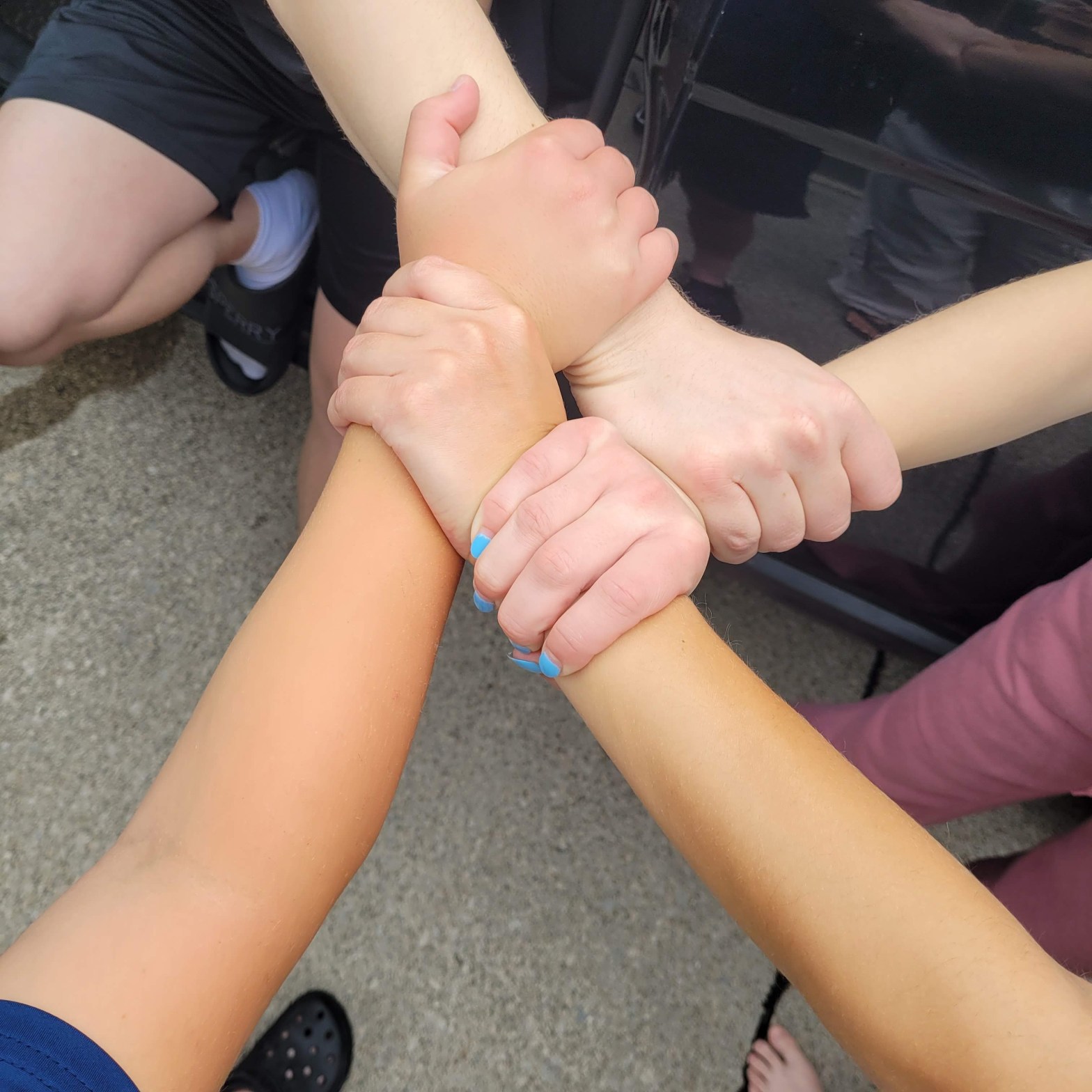
Similarly, think back to when you were with a friend who was telling you a story. Did you notice that your facial expression might have changed in concert with your friend’s expression? When someone recounts a happy event, they smile and we smile. When they share a distressing story, often their smile will fall or their forehead will furrow, and our face will offer the same expression back to them sharing that we understand and acknowledge their experience. The same is true for our counterparts when we are the ones who are telling the story. This is the work of our mirror neurons. They help us connect to one another and make empathy and compassion possible.

Togetherness

Takeaways

To experiment with interpersonal neurobiology and mirror neurons, the next time you are working with a student, or spending time with a friend (in person or online) try this practice:

  • Pause to notice your body-mind connection (what’s going on within you).
  • Take a deep breath and notice any change in your system.
  • As you interact with the other person, notice the cues they are sending through their facial expression, body language,and tone of voice (what’s going on with them).
  • Pause again to notice how your body is responding to the signals you are receiving (what’s going on between you).
  • Notice: How does this awareness impact your experience? What do you notice about your sense of safety and connection? Their sense of safety and connection? Does this noticing give you the space to make wise decisions about what you will think, say, or do next?
Photo by Andre Mouton on Pexels.com

Mirror Games

One way to experiment with IPNB & mirror neurons is through play. Try these games with your students, children, or even friends as a way to enhance understanding of social-emotional well-being:

What Am I Feeling?

Young students gain a better understanding of their emotions and the emotions of other people when playing “Guess What I’m Feeling.” To play, create the appearance of different emotions through facial expressions. (This still works with masks on, and can really help us make sense of facial expressions that we see from the eyes up.) Make a happy face, angry face, sleepy, or disgusted face and have the students guess what you are feeling each time. Go through as many different emotions as you like. Notice if any emotions have similar facial expressions and discuss this with your students. For instance, if sadness also looks like disappointment, how can you tell the difference? What other clues can you find in body language? Notice if your students end up making the same faces you do as they try to figure out which emotion you’re demonstrating. You can also have the students think of an emotion and be the leader.

Mirroring

This game strengthens students’ ability to pay close attention and to tune into the experience of others. Have students pair up, seated or standing, and take turns moving slowly and imitating each other. One child will slowly move their hands, arms, face, or head, and their partner will try to mirror them with the same slow movements at the same time. Encourage the student who is mirroring to stare at the center of their partner’s forehead as a point of focus, and use their peripheral (indirect) vision to notice the movements. Set a timer for 1 minute, then switch.

Bonus Benefit: Practicing with peripheral vision can enhance a sense of safety and allow students to move into the learning state of mind, accessing the limbic system and prefrontal cortex needed for receiving, storing, and recalling information.

*Bailey et al., 2011; De Palma et al., 2014; Moloney et al., 2014