Hurry Up (& Rest)

Hey there, Dear Yogi,

How are you feeling?

Close your eyes, breathe deep. What do you sense in your body?

For a long time I felt a sense of urgency. Do you ever feel this? Not the fun kind in which you’re excited to get all your ideas out on paper or when you’re bursting with news to share. I’m thinking about Time Urgency in which you have to get a certain amount of tasks (enormous, tiny, complex, and simple) completed before time is up! And that timer can be anything: the baby’s nap, the deadline, the reservation, the family’s dinner, the board meeting, the presentation, the teacher’s meeting, the test, the class change, the committee meeting, the bell, The Meeting, the clock.

Photo by Jordan Benton on Pexels.com

Types of Clocks

I still feel it now, though not as intensely and not as often. And not because I’m evolved or enlightened, but because time has passed, and I have don’t have babies anymore. But if I did, I’d tell myself to hurry up and rest.

Back then I raced the “baby-clock” in Every Single Thing I Did: yoga asana, laundry, meditation, dinner prep, reading, tidying, writing, sweeping, posting, lesson planning, planting, grading, visiting, sending, gathering. The baby-clock looks like this: until the baby wakes, until the baby cries, until the baby wakes, until the baby cries, and on like this day after night after day after night.

Time passes and the toddler-clock looks like this: until the educational tv show is over, until the toys are boring, until someone gets hurts, until someone gets angry, until someone gets hungry, until someone screams, and on like this day after night after day after night. And all the urgent tasks are scattered throughout. Half done.

The little kid and big kid clocks look more like this: time for soccer, time for piano, time for games, time for a date with mom, time for violin, time for rehearsal, time for church, time for school, time for play, time for tv, time for silent reading. And also, time for breakfast, time for snack, time for lunch, time for snack, time for dinner, time for snack, time for bath, time for bed.

I answered all these clocks in the obvious and necessary ways for a long time. Then my answer to the kid-clock slowly grew (along with my children’s age, capability, and reason) into little bits of silence: “Mom’s not answering you because she’s meditating.” And this: “Mom, why are you upside down?”

Photo by eberhard grossgasteiger on Pexels.com

Cultural Expectation (?)

I did rest a lot. But I kinda wish I’d have rested more back then, and not just my body, but my mind. The sense of time urgency was largely in my mind. I wanted to get everything done everyday. The urgency to produce and do it efficiently was heavy and oppressive. Produce anything: a folded load of laundry, a meal, a clean room, a poem, a journal entry, a completed lesson plan, a smiling baby, a plate of cookies, an empty trash can, a graded stack of essays, a happy family, a successful class. All my worth was tied up in it, even when I told myself that simply growing and raising human beings was enough, that simply showing up was enough. Efficient Productivity Loomed.

I don’t know why this was such a part of my way of being, but my guess is that western culture saturates us with the idea that our worth is based on how much we can produce and whether or not we can produce it efficiently. Can we do it better, cheaper, faster? Try. Can you make your family happier? Try. Can you get more papers graded in less time? Try. Can you clean, cook, plan, and create at the same time? Try!

Hurry Up & Rest

If there’s a sense of urgency now, while I have big-kid-clocks and young-adult-clocks all around me, it’s this: sit down, rest, stand up, rest, turn upside down, rest, lie down, rest. Practicing ease, allowing, and unfolding helps me do this. I’m inviting you to find rest alongside me.

It’s good to remember that rest doesn’t necessarily mean sitting down, lying down, sleeping, napping, “doing nothing,” or “just being.” Play is really, really, really good rest. So, I’m inviting you to play, too. Play piano, play painting, play yoga, play ball, play games, play meditation, play climbing trees, play knitting, play visiting, play telling jokes, anything just for the fun of it.

Photo by Pixabay on Pexels.com

To Experiment

To practice being restful rather than being productive every waking moment and even in your sleep, consider recommitting to your sabbath practice or your dedicated time-off. Or try pausing for a moment to consider what is necessary, then do that one thing and leave the rest. This section is not about time management. This section will invite you to notice how you value your time and how you value yourself. After a couple days of practice, you might begin to shift, just a little, the way you move through the world.

Your unique set of circumstances will affect how the details shake out for you, but here are a few ideas to get you started. Try one that seems supportive or interesting, or try them all over a couple of weeks.

  • When pressed for time with a lot to do, ask for help. (Crazy, right?)
  • If faced with a daunting to-do list (that might be partly self-imposed), decide in the morning what is necessary for today, and what can shift to tomorrow.
  • Ask yourself what you value most in any given day. Take 3-5 minutes to journal or sketch about this and allow your answers to inform your choices for the next 24 hours.
  • Notice if you experience a resistance to resting or if you crave it, or both. When you rest do you feel bored, unproductive, or worth less? Do you notice a sense of receiving, renewing, or ease? There’s no right answer. Any answer will supply you with interesting information.
  • Do you experience a sense of all or nothing, either work, work, work, or rest, rest, rest? What would it be like to work a bit then rest a bit? What do you allow yourself to do when you’re “on vacation” but not when you’re “at home?”
  • If you have an aversion to “being unproductive,” consider the perspective that resting will make you more productive in the long run. Not the purpose of this practice, of course, but it just might get you to experiment with resting and see what it’s like!
  • Find an accountability partner. Check in with each other to support adding a dose of restfulness to your days.

No matter how productive we want to be, no matter how much we want the to-do list checked off, there are just some things that have to unfold in their own time. So maybe consider allowing things to unfold. Remember, you can’t feed the kids breakfast before they’ve had dinner.

Happy Resting, Happy Playing,

Amy

The Universal Yogi

PS – I forgot the pet-clock! There’s a pet-clock, too, the puppy-clock, the aquarium clock, the list goes on!

Photo by Christian Domingues on Pexels.com

Jewels: The Sweet Gems of My Reiki Level 1 Experience

“Reiki energy speaks for itself.  

All other descriptions are only approximate.”

~ Reiki Level 1 Manual, Yoga on High

It’s tough to put the experience of Reiki training into words – Reiki is so beautiful, so life-giving, and so was my training. 

I had thought about investigating Reiki at Yoga on High back in 2003, and off and on for years, but I had never felt comfortable going for it, and it seems the universe had different timing in mind.  What a joy to have been able to take the training in person just weeks before the pandemic lockdown orders came in March.  Timing couldn’t have been sweeter. 

I wanted to share a little bit about my takeaways here, just a sweet distillation of the immense amount of wisdom I received, the jewels that stood out for me.  Every person has a completely unique experience, of course, and this is just mine.

  1. A Spiritual Practice

There are no caveats about it.  The opening instruction was, “Reiki is a spiritual practice.”  This acknowledgment was so refreshing.  There was no pulling reiki out of a spiritual tradition and secularizing it somehow.  We dove in and discussed universal life force energy, and all were encouraged to connect and engage with the practice in a way that was authentic to our own spiritualities and/or religious traditions.  

  1. The Five Precepts

The five precepts recited during the Gassho Meditation are a way to “calm the mind and bring heart-centered focus to the healing session.”  We were taught the traditional precepts and then – the most marvelous thing – we were given permission to make them unique to our own experience(!).  

The traditional phrases include releasing anger and worry while embracing gratitude and honesty, as well as an intention to live in the present moment with kindness.

I use the traditional precepts often.  But sometimes I substitute “notice” for “release,” and I’m going to try out using, “I am whole,” ‘I am fierce kindness,” “I am honest,” “I am loving kindness.”  

For me, this is similar to the way I pray or set intentions before I teach a yoga class or consult with someone.  I practice letting go of self/ego and allow whatever is meant to be taught, expressed, learned, or experienced to be present during the time together.  

  1.  The Hara Line – Grounding & Centering; Flowing Through Your Heart

I had heard of the hara line before, but never had any formal training in it, and I had certainly never practiced extending it beyond my body to connect to something larger than myself.  This was an amazing experience and one that has stayed with me, manifesting itself often now when I center, ground, or sense into and expand my energy.  My guide offered these practices when she was teaching us how to enliven our energy and tap into an energy source bigger than ourselves.  This reinforces and actualizes the truth that “giving reiki” is not a draining practice, but one that is self-nourishing and replenishing because we are not giving of our own stores; rather, we are channeling the universal healing energies of Love.   When I come into a place of stillness, whether before teaching a yoga class or guiding meditation, I practice tapping into this energy line connecting me to the core of the earth and the cosmic energies above our atmosphere.  It is a radiance of imagery with myself at the center and gold glowing lightstreams of energy flowing up, down, and through the hara line all surrounded by the cosmos.  I can invite the energy from the larger light source (or star) down through the crown chakra, through the throat chakra and into the heart at any time.  I can then allow and invite the energy to grow in my heart chakra and course down through my arms and into my hands, palms, and fingers.  This allows me to enjoy the healing reiki energy as I share it.   

  1. Trust the Reiki Energy 

This trust is one of the main teachings of the practice:  trust the reiki – it knows where to go and what to do. There is freedom, joy, and ease wrapped up in this Trust.

Photo by Felix Mittermeier on Pexels.com

I am so grateful to have received this training in person.  It has been one of the great blessings in my life.  

You might be wondering how all this jives with my “Christian-ness,” but that is for another post!

In the meantime, if you’re interested in learning more about Reiki, follow this link to read about Yoga on High’s Reiki tradition.

Wishing you wellness, ease, and deep trust,

Amy

The Universal Yogi

What’s your Word?

Hello, Friends,

What’s your word?

I’ve had people text me this question recently, and have also encountered it in my coursework lately. For the last several years I’ve been using a guiding word like a north star but had completely forgotten about it this turn of the calendar. Thankfully, other people in my community have remembered! Typically, I use the first few days or weeks to let the word reveal itself, but I’m already thinking it’s something like Unfolding.

Your One Word

Your one word is what you want to practice for a set period of time. It’s like setting an intention about what you want to bring into being, or manifest through your thoughts, speech, and actions – how you want to show up in the world. Your one word is like a deep distillation of your heart’s desire, the diamond sparkling at your core.

Your word might reveal layers of your hopes and aspirations, what you hold dear. It can be anything that feels uplifting, encouraging, or inspiring. Last year my word was Ease, which wasn’t easy, but then a curious thing happened. “Allow” cuddled up right next to Ease, and I realized a certain amount of allowing was asking to be invited to my party. Ease needed a friend, and Allowing knew it. This speaks to a long held pattern of behavior in which I try to orchestrate, set up, and navigate everything and everyone so that everything and everyone can have the best-possible-experience-ever in any given situation. Well, one can’t experience “Ease” when one is busy doing all of that.

Photo by Rakicevic Nenad on Pexels.com

It’s Foundational

Your one word becomes the foundation from which you move.

Without realizing it, I began practicing allowing as a way to practice ease. This “without realize it” thing is key. The reason this can happen is because the one word is a sweet concentrated nectar that saturates other layers of our being. It doesn’t just “stay in your head.” After seeing it posted it on your walls, mirrors, & shelves, and repeating it while you walk, drive, and breathe, pretty soon the word is in your muscles, bones, & blood, similar to praying without ceasing; or really, it’s similar to anything you practice intensely to the point that you no longer need to think about it, like the violin, the sun salutation, shooting a basketball, typing on a keyboard, knitting, etc.

Practicing your one word is like building a new habit, the same way we might employ new behaviors during Lent or Advent. After several months my body-mind was functioning from a foundation of ease. This doesn’t mean I felt stress-free or easeful all the time (or any of the time). It means that because I wanted to feel ease in my life, I made decisions that would help bring this about. I would ask myself, “Will doing this bring about ease? Will I experience ease if I continue to talk about these things or keep quiet about these things?” Or “Is thinking these thoughts creating ease or blocking it?”

I didn’t need to make a conscious decision to practice “letting go of control.” Instead, my body-mind began incorporating the practice of allowing things to be as they are because I was basing all my decisions on a bedrock of ease. My being knew from experience that this had a way of bringing about the opposite of constriction, grasping, striving — you know, Eeeaaase. So while I wasn’t trying to exact control over every single external circumstance that made up the situations of my life, I was more in control of how I experienced my life, how I actually lived it.

Photo by Maria Orlova on Pexels.com

Variation

Maybe your word is an image. I happen to be word-oriented, but maybe you are super visual. What kind of image would you use as your guiding light through this next day, week, or series of months? Take some time to imagine, visualize, draw, or sketch. Or spend some time searching images on the internet, digital museums, or in books. Maybe find a scene on your next walk, run, or hike. Take a pic with your phone or just let it imprint in your mind. It might be something that offers you a sense of uplift, encouragement, inspiration, or awe.

The Wrap Up

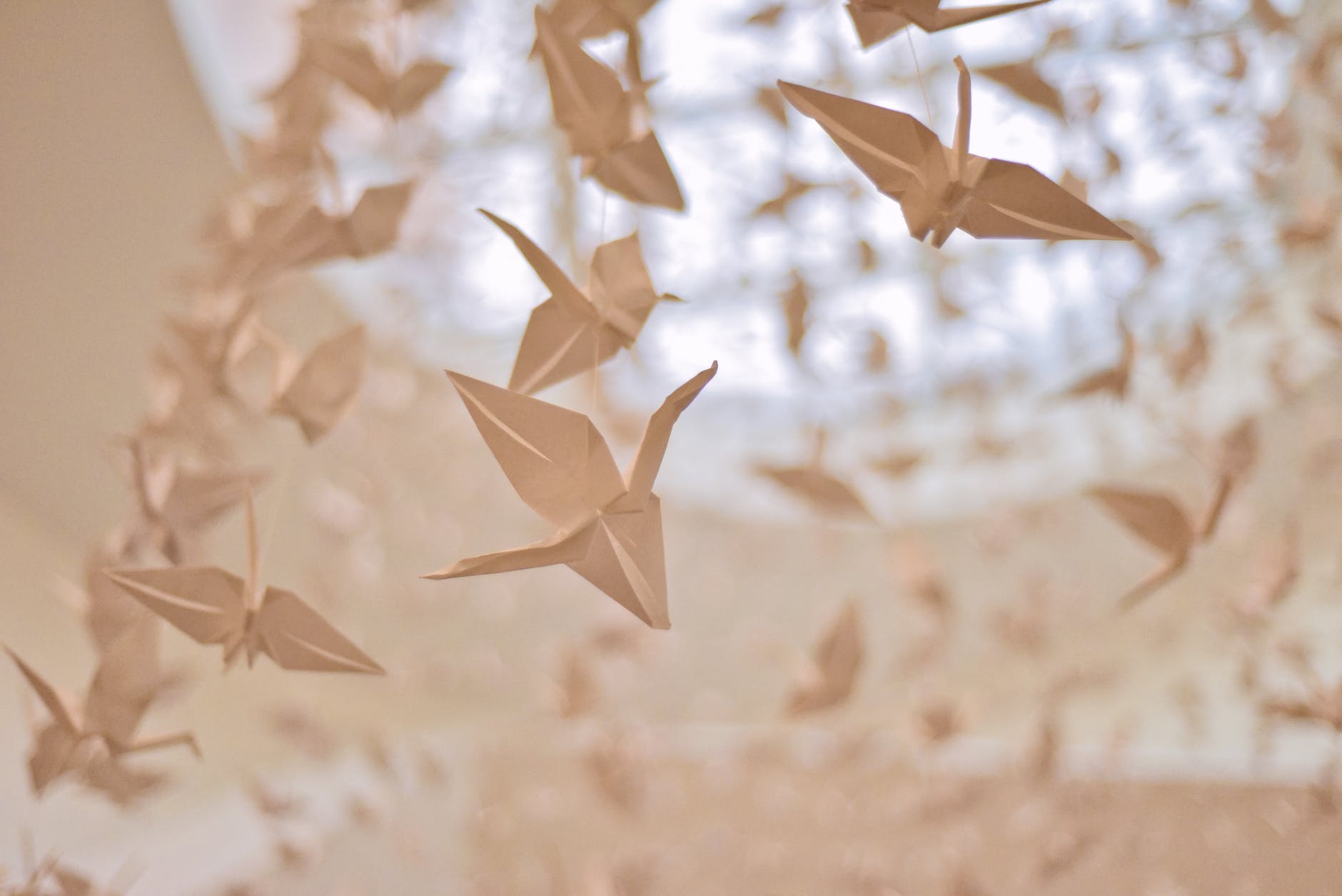
My meditation teacher speaks of the ways we might sometimes “origami” ourselves and other people into different packaging so that we, and they, are “more palatable.” I know that I have done this (for a looooong time!) and practicing ease & allowing has made this impulse less intense. It’s no wonder, then, that my new word is revealing itself to be Unfolding even as I write this post!

Some things to try:

  • Spend time in meditation, contemplation, centering prayer, some combination, or any other inner listening practice, and be open to whatever arises. Spend time walking, running, hiking, or any other meditative movement practice and be open to whatever arises.
  • When something arises, words, concepts, images, textures, sounds, colors, look beneath them asking what else wants to be seen or heard.
  • If something strange or unsettling arises, make a choice as to whether you feel resourced enough to engage with that. If so, inquire what might be underneath, what else wants to be seen or heard.
  • Be open to your unique guiding light or north star. You might have a word, an image, or even an sound.
  • Take steps to distill, concentrate, and saturate. If you start out with a sentence or series of phrases, distill down to one word. If you start with a series of images, concentrate on one aspect. If you start with a symphony, choose one tone.
  • Post it everywhere so that you see it. Repeat it constantly so that you can hear it, feel it, and maybe even taste it. Find ways to act it out once each day. Record it and play it back so that you can resonate with it. (Not sure how this works for an image, but maybe it’s a spoken description.)
  • Have Fun!
Photo by James Wheeler on Pexels.com

Unfolding, for me, feels like allowing space for people to stretch out, and maybe even blossom. This is true for myself, as well. Unfolding might feel uncomfortable. It’ll take time to allow the creases to smooth out. I might need to bend the other way for a little counter-balance. But that’s okay. I’ve got resources to lean on and dip into (yoga, family, God). Plus, the days keep coming, whether we like it or not, so there’s always more time for practice.

Wishing you many amazing, crazy blessings right now and then also the next right now,

Amy

The Universal Yogi

PS. Feel free to get in touch and share your word, image, or sound. It’s fun to share! Email amy@thecatholicyogi.com.

Photo by David Yu on Pexels.com