
Last Week In Yoga: Both/And

Welcome to the “This Week in Yoga” Series.

I know, the title of today’s piece is “Last Week in Yoga,” but the idea has come a week into our first series, so, better late than never!

The concept we worked with last week is the idea that two seemingly disparate things, or, sensations, emotions, and thoughts, can co-exist.  For instance, if one of your most physically challenging yoga poses is Revolved Triangle (parivrtta trikonasana) or Crow (bakasana), you might consider inviting a sense of ease into the pose by unclenching your jaw, or directing your gaze downward, lengthening the cervical spine.

Try it out (follow the links above for direction):  once you’re in each of the postures, first, clench your jaw on purpose then let go;  second, tip your face toward the front wall, ceiling or sky, then angle your nose toward the ground.  Notice there is space between the upper and lower teeth, and space between the back of the head and back of the neck; tension is released, and ease is uncovered.

Now that you’ve created all kinds of space, notice how empowering it is to feel the strength throughout the length of your back leg, your side abdominals and back muscles, and your supporting and extending arms in revolved triangle, as well as your “everything else(!)” in crow pose.

The intention of practicing Both/And is to embrace the fact that ease exists alongside intensity.  Our yoga practice doesn’t have to be “all intensity” or “all ease,” “all 20190105_1022274695271670129936073.jpgstrength and high energy” or “all rest and relaxation.”  This Both/And practice allows us to circumvent an experience of Either/Or: either complete boredom and atrophy, or, overwhelming strain and exhaustion in our mat-based (sometimes vinyasa) yoga practice.  Instead, we get to experience our own power, the power to notice and acknowledge all that is present in the moment, which is no small accomplishment.
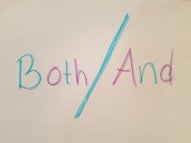
Keep in mind, our power is also a piece of this Both/And journey, for power is not strength alone, but a combination of strength and grace, and maybe even courage.

Happy Practicing!

The Catholic Yogi


A Getting-Ready Prayer

puts on bracelets:         

God be in my arms and in my strength
in my lifting
embracing and letting go

puts in earrings:            

God be in my ears and in my hearing
in my listening
understanding and honoring

puts on necklace:           

God be in my throat and in my speaking
in my conversing
expressing and silence-keeping

puts on eyeliner:            

God be in my eyes and in my seeing
in my viewing
framing and witnessing

puts on lip balm:            

God be in my mouth and in my empathizing
in my acknowledging
celebrating and lamenting

looks in mirror:               

God let me bring about the kingdom
enter the Flow
and do the work of love

What is Trauma-Sensitive Yoga?

I’ve been studying at Yoga on High these last few months and am halfway through the EMBER curriculum.  It has been a fascinating and rewarding journey.  I have amazing teachers, and equally amazing classmates.  By the end of April, I will complete the 100-hour EMBER certification, qualifying me to teach Mindfulness Based Emotional Resilience yoga classes.

Below you will find a description based on Yoga on High’s explanation of EMBER classes, as well as a quote borrowed from their site.  If you feel you would benefit from this type of class, please visit the contact page and let me know.  If there is enough interest, I would love to put one on the next schedule.


Trauma-sensitive yoga classes differ from traditional yoga classes in language, physical adjustments, and intention or focus.  A trained trauma-sensitive (or trauma-informed) yoga instructor will use the language of invitation and inquiry, will not offer hands-on adjustments, and will continually offer options and encourage choice as a way for students to cultivate a sense of empowerment.  The focus of a trauma-sensitive yoga class is not strength, flexibility, or stress-relief, though these might be happy side effects; rather, the intention is to create a safe space for the student to explore gentle physical movement and breathing as a way to communicate or reacquaint herself with her body.

The classes are structured to be predictable, beginning and ending in similar ways each time, with special attention paid to the types of props used, if any, and the potential for certain postures to bring about feelings of vulnerability.  Students are not only encouraged to make their own choices about how to approach a particular shape, but also to opt in or out of any portion of the class at anytime.

“Because strong emotions may arise and be released during and after a somatic practice like yoga, [it is] suggest[ed] students also work with a psychologist, psychiatrist, or other mental health professional while on their healing journey.”

“Yoga allows survivors [of trauma] to regain a sense of comfort and ease within their own shape, to process nonverbally feelings that transcend language, and to experientially cultivate gratitude towards the body, which serve as a reminder of one’s resilience (Boeder, 2012).”