
Hi Yogis,
Last week in yoga (I know, someday I’ll catch up) we worked with the concept of unfolding. In a mat-based yoga practice, this means two things: 1) we allow the pose to unfold during the course of several breaths, and 2) within the pose unfolding, the body unfolds, as well.
For instance, when practicing Utthita Trikonasana (Extended Triangle pose), instead of leaping into a pre-conceived “final” version of the pose on breath #1, we start gently by simply reaching to the side with straight legs, both arms parallel to the floor. On breath #2, we lower the front arm, pressing the back of the hand gently into the inside of the front thigh, or, resting the palm on a block, while the back arm drapes behind the lumbar spine. Breath #3 will take the fold at the hip deeper, if that seems wise, and the bottom hand closer to the floor.  The top arm is invited to reach upward, and the gaze is directed to the ceiling, side wall, or floor. Breaths #4 & #5 will offer the space to remain, back out, or go deeper into the pose. In this way, we take the pose in stages, which allows the body to warm up to the shape without any pressure to find the edge. Only by the final breath(s), if it seems wise to do so, will we explore the edges of the pose as they manifest uniquely in each of us.
During practice, we unfold the pose and the pose unfolds the body, so that by the end we might feel like we’ve arrived in a totally new place, not just “regular old triangle pose.” The fuel for all this unfolding is the breath. It is in each inhalation that the body expands and creates space, and in each exhalation that the body stabilizes and grounds. In this way, the breath acts as “the great unfolder,” a beautiful thing to experience.
Happy Practicing,
The Catholic Yogi

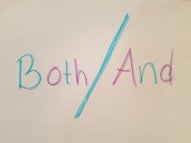 strength and high energy” or “all rest and relaxation.” This Both/And practice allows us to circumvent an experience of Either/Or: either complete boredom and atrophy, or, overwhelming strain and exhaustion in our mat-based (sometimes
  Generous Wisdom | Spacious Heart