

Courage is meeting ‘the heart’ – where ‘the heart’ is the pulsating vitality of things, of ecological things, that bends you into new shapes. One does not “have” courage; one is summoned by it. Anointed by it. Touched by it. Bayo Akomolafe
What is aliveness?
Is there meaning here in this word for you?
Does it bubble? Does it buzz?
When do you feel most alive?
When you wake? When you dream?
When you fall sleep at night?
When you watch someone ELSE come fully alive?
When my teachers tell me they study aliveness and what blocks it, I think about the blocks: the fear, the pain, and the fear of pain. Interestingly, these blocks also function as motivators for some, when they are not actively discouraging us from stepping into the wild beyond.
I study what it means to be human.
I look closely at humanness with all my attention in all its iterations.
Aliveness is wrapped up in that. In humanness. And so is deadness.
When I coach middle and high school students in whole-being-resilience, many will tell me they get through difficult situations by simply “not caring anymore,” and I think, what a brilliant protection. What an ingenious defense against fear of losing love, against the pain of betrayal, against the threats of ostracism. Aliveness gets stopped at the source then. It gets flattened out. All the bubbles squashed because not caring is the best defense against the danger of being hurt.
In our experience of humanness, deadness is there. too.
Aliveness and deadness together.
Effervescence and flatness.
We are like water.
Stillness
the reason we can feel undulation.
Many animals feign death in order to survive. And many of my school-aged students protect their emotional body by “being dead inside.” That’s way safer, “so much easier,” they say. And yes, it can be and it is. And it is necessary at times.
When deadness becomes a way of being it disallows its opposite. When we immobilize our emotions so as not to feel pain, we block pleasure, too. This is the nature of our reality. So, when we decide we’ve had enough deadness, aliveness is accessed by accepting the fact that we might get a little bit hurt. We open up little pores to let sweetness pass through our experience. Is it worth it? Perhaps. It always depends.
Coming back into aliveness sometimes feels like coming home. Some of us don’t know what “home” feels like, though, especially if the definition is “safe and secure.” I’m thinking of a particular student who spent about two years not “feeling safe” anywhere, ever, no matter what. In this sense she was homeless. And this is the reason I – almost always – start by inviting students to explore different physiological ways of creating sensations of safety within their own body, which is the only home we ever truly inhabit.
Coming back into aliveness isn’t necessarily easy, unless it is. And it can actually be quite difficult, unless it isn’t. And some of us don’t want to find out because, again, pain and fear and fear of pain.
When we decide that the pain of staying the same has finally become greater than the pain of change, or the fear of that pain, the blocks turn into motivators. We start to build our capacity to manage discomfort, to be with unease and not-knowing. We have to resource ourselves for this, find our own kind of ground and steadiness, what feels stable to us personally, uniquely. It’s a little like sitting still and then feeling your body rock forward and back from the force of your own beating heart. There’s movement, but you’re not doing it. Not necessarily, you know, your body’s intelligence is creating that kind of movement, not your conscious mind’s choice and action. There’s a vulnerability in this sitting with your own self, an openness to what is.
And then there’s a waiting,
a receiving,
and a waiting some more.
Vulnerability might be an unsatisfying word here. I might mean porous, as Frank Ostaseski teaches. And maybe I even mean portal.
The sacredness of being alive might actually be in its closeness to death. There is yoga here. Precious, precious yoga, unity, wholeness.
There is yoga everywhere.
Every inhalation I am born.
Every exhalation I die.
When I was lifted from the innermost space
of my mother’s body, through the surgeon’s multiple incisions,
through all those layers of precious muscles and tissues,
when the fluid cleared my airways, I breathed in.
There will be a day when I breathe out.
Now, writing is breathing for me. I’m closest to aliveness in this space of creation. It doesn’t matter if it’s poetry or prose, verse or lines, phrases or lists. It doesn’t matter if it’s published by me or by someone else, if it lives between the covers of a journal, a notebook, or a binder, or if it’s on the back of a receipt set on the kitchen counter right next to all the mail and the popcorn machine. When I write, I breathe. When I don’t, well, I die inside.
Everything gets stopped at the source then, all the bubbles and vibrations, all the airiness and floating, it’s all flattened and squashed. All the water, All my creative waters, my sacral waters, my svadhisthana, stagnant. Stagnancy is death.
Some of us are pulled into aliveness, others of us step in tentatively, inquisitively. And there are those of us who make ourselves as small as possible to protect our dear, sweet hearts. We cling – sometimes – to the mattress, make ourselves as low to the lower surfaces as possible, our vital organs hidden and inaccessible to threat. In these moments and phases we have forgotten that the energetic heart can never be wounded. No matter what happens to our emotional heart, our energetic heart is always full, always whole. All of us fluctuate and pendulate between these places of being pulled, being curious, being flattened, between feeling broken and feeling whole, between encountering discouragement and encouragement. There are so many times during which we feel we have been dismembered, and so many times we feel we have been re-membered.
Sometimes aliveness invites us to bend into new shapes, and that takes a little bit of something: maybe curiosity, maybe letting go, maybe wildness, maybe some “couldn’t-care-less-ness,” maybe willingness to experience whatever-comes-next-ness, without perfectionism. Without Perfectionism. Because it isn’t over – this life – it isn’t over or I wouldn’t be writing this and you wouldn’t be reading it. Whatever comes next might be unpleasant and uncomfortable, maybe. Or it might be pleasant AND comfortable. Or, it might be BOTH. Probably both. Oh, The Layers.
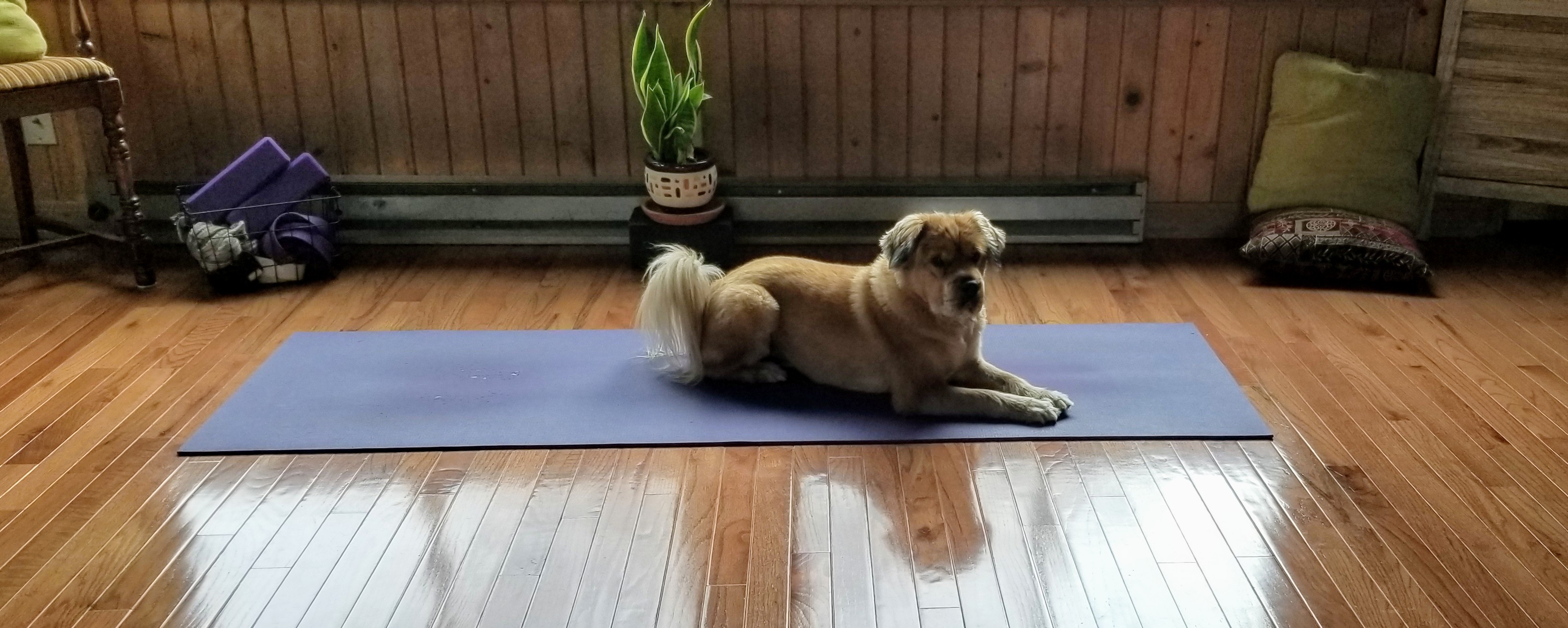
Asana is a Sanskrit word from the yoga tradition that is often translated as posture or pose. I’ve taken to translating it as shape. Bending into new shapes has the potential to unlock sweetness for us. We stretch out the muscles and tissues and open up energies that were forced into stagnancy. Some of us feel bubbly and effervescent after a Yoga-Shapes practice. Some of us cry. Still bubbly, though. Still the bubbles. The Practice of Moving and Breathing in a “yoga-sense” (on purpose) is a practice that is in service to us and our bliss, not the other way around. I don’t “do yoga” because I “have to” or because I “should.” I play yoga because I want to. Because it makes me feel better. Period. Yoga asana practice puts me in a different relationship with gravity, with the ground, with my body, with the air, with my breath, with the sky, with my thoughts, with the walls of my rooms and the humans in my house. (Yes, and the puppy, too.)
I have practiced and played so much yoga-asana over my lifetime that it lives inside me, the uncovering of wholeness. All I have to do is re-member. It only takes a second now. My body drops into death-pose anytime I imagine it, and all my pieces come back together, reveal themselves as connected. I don’t even have to close my eyes if I don’t want to. This doesn’t mean you have to practice for over half your life to access settling-into-ease-ness. For some people it happens so deeply the first time they practice, and their nervous system was so primed for the experience that it stays with them and is only a second away. For most of us, though, practicing often is a sure way to build paths into sweetness.
I don’t always re-member, though. I don’t always every single time bring all my pieces back together during challenging moments. Sometimes I fall apart and keep on falling apart, and this is our human experience: fall apart and come back together, over and again. I don’t fall as far or as often as I used to. My younger, less-practiced self had little idea what she was doing, and I’m still not sure, and I never will be. But I know enough now to know that I don’t know. And when dropping into ease feels insufficient, I ask for help.
When I am deep in it and no amount of body-shapes are enough, I bend my mind into new shapes: Instead of lamenting, “Why is this happening to me?” my friends and my teachers invite me to ask, “Why is this happening for me?” And so I try on this new orientation to gravity and
it feels terrible, like, what the actual f*ck. But then it feels like
Crazy-Magic-Freedom.
Lightness.
Un-trapped-ness.
And after I notice, name, and Be With my despair, bitterness, and self-absorption, my brain breaks open
and my body expands and
I find myself in the buoyancy
of my common human experience.
And I am not alone in my being
or in my learning or
in my deadness or my aliveness
because I am you,
and you are me,
and in a certain kind of way,
we are
here –
together,
as it were.
In different bodies.
When I look for the gift of what is happening, and I look for the healing inside the potentiality of my circumstances, I find something to release. And when I don’t, I wait. And then I find something to let go. And when I don’t, I wait. I heal my self in this action of patience. And you heal me, too, because we’re connected, all of us. And each time I let go of something I get lighter. And so do you.
Each time we set something down we create space for something new, for possibility, for something that serves us in the loving and being loved. The ancient, modern, and future ancestors share their wisdom: courageousness calls us, pushes, and pulls us, whispers to us in the night and in the morning, and comes to us through pictures and poems and music and songs and rhythm. It also comes through screams and destruction.
Catch it – can you hear it? Courageousness.
Release your grip on the mattress, open your hands and feet away from the floor – can you feel it?
When you meet your heart in all of its beating – can you feel the courageousness? Rippling through your pores
and sweeping through the transparent mountain that you are?
Aliveness. Bubbling up to the surface
from the never-ending well
of unconditional connection
in the deepest place in you.
The core of the cave of your own dear heart.
The energetic heart
your life force portal, prana flowing flowing flowing from the Silence into the silence
you know that silence that is never quiet but still and always sweet and still and always bubbly.
Is courage the force of life? If courage summons us, anoints us, touches us, as Bayo Akomolafe says, what can we do, what must we do, what will we do but allow it?
I don’t have the answers to these questions.
Often, I’ll text my closest friends things like
- wtf are we doing here?! [on earth]
- how many layers, levels, and dimensions? how many?! [must we go through and/or experience constantly all the time at the same time]
- Life is SO f*cking weird [like, really truly, ridiculously weird]
- I am tired of learning [so. so. so. t i r e d]
This miniscule sample of my messages is indicative of my human need for connection, affirmation, and validation. It’s also an indicator of my human burn-out response. Learning is my favorite thing, friend, my favorite thing! Being tired of it at various points in my life tells me my nervous system is At Capacity. I need to either build capacity or change my systems. And after talking with my dear friends, who support me in all kinds of ways all the time, sometimes I do both.
Throughout all these communications, whether I’m writing or speaking, the ratio of my questions to my observations is about equal. One of my teachers did not offer a Q & A after her workshop but instead offered a Q & R, and I loved that. I, also, have no answers, only responses. This new way of approaching life, this bending my mind into a new shape helps me care for my perfectionism. It allows me to write and press publish knowing there is room for improvement. Like right now, too.
Knowing there is room for improvement in everything I create helps me stop procrastinating. None of my work will be perfectly indestructible, irrefutable, or stand-alone because life is huge, layered, leveled, and multidimensional. I simply can’t write everything I want to share in one article, one poem, one essay, one blog post even though I’ve always wanted this.
Perfect is a kind of completeness. Perfect is an end.
As long as I’m alive
there is no complete
so I keep writing
I keep inhaling and exhaling
standing up and lying down
falling apart and remembering
I keep playing with all the shapes
and resting in the sweet approximation of death,
the end of yoga asana practice
Savasana, the beautiful corpse
in which we need not change or fix anything,
Only be.
Only be held.
Only allow.
Only allowing.
When I die, will my life have been perfect?
YES.
Until then
I see the blocks to my aliveness and I honor them.
Until then
I see the motivators for my own movement
into prana portals and I accept them.
I forge the paths into my own sweetness
and when I meet my energetic heart, in all its “pulsating vitality,” I will encounter the courage that sustains me.
And you will, too.
Right?
Because this is a together thing.
Our hearts blessing us from the center of our being,
aliveness bursting like tiered fountains
arcing, pouring over each other,
waterfalls bending into new relationships with gravity
and you
laughing
alive
allowing YourSelf
to be moved
to be breathed
undulating water in the stillness of
being
home
Thanks for reading all this way. There just wasn’t a tldr version to share. Maybe it could’ve been: go outside and blow bubbles?
Thanks for being in the flow with me. My aquariusness is vibrant right now. (As if it ever wasn’t).
More again soon,
A,



 Generous Wisdom | Spacious Heart