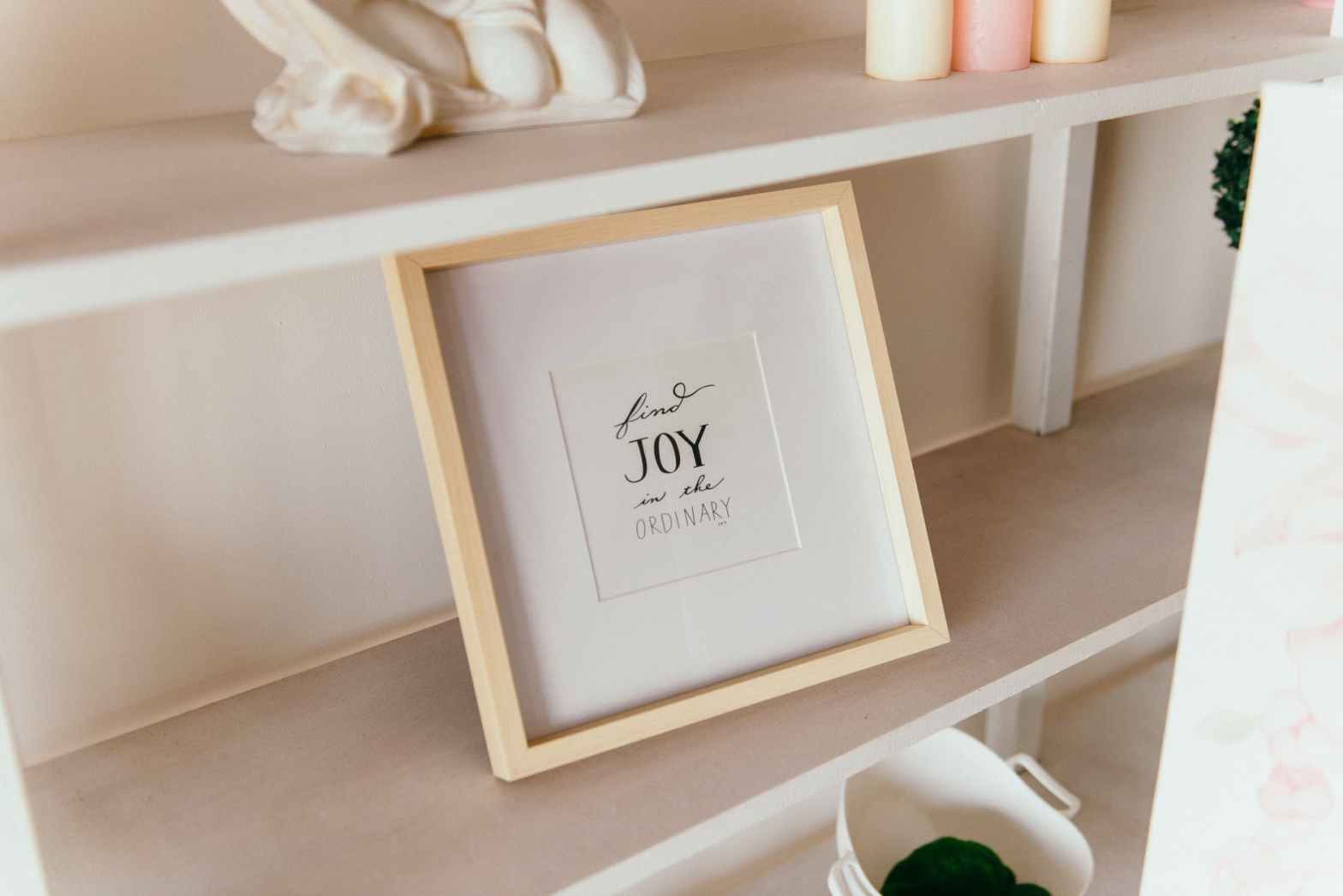
My family has chosen “Joy” as the theme of our last week of Advent (even though it really doesn’t matter). For years my intention in practicing Yoga was to find, manifest, exude, realize “my true nature,” Contentment. And then one day on my first silent retreat, which happened to fall into the virtual zoom world of the 2020 pandemic lockdown, I had a realization – maybe I should be going for Joy. Seems crazy, but in my efforts toward living a contented life, I had employed non-attachment to the degree that (maybe) I had (unwittingly) crossed joy off the list.
Not that I had already experienced enough joy and so I didn’t need to experience it anymore, but that it had become a thing I thought I didn’t need because I was content. (Such an interesting turn of events!) It’s possible that aspiring to a joyful life can seem indulgent, privileged, or naïve, so, not necessarily a “good thing.” However, during a period of journaling on that silent retreat, it occurred to me that perhaps I was selling myself short, barring myself from some real sweet moments. It was like – Hey, why not Joy?!
I think it’s in the striving that I get caught. When I effort after everything, that’s when I get tired. This includes the “good stuff,” like contentment, children laughing, time for rest and being together. When I allow life’s moments to come to me, and I experience them without judgement to the degree that I’m able, there’s a peacefulness present regardless of the negative or positive flavor of what’s happening. The peace is there because I’m not striving or “efforting,” willing everything to go the way I think I want it to go.
As an observation, I don’t strive toward despair or “alone-ness,” and yet these emotions come my way. I practice non-attachment for a little space between myself and them and as a way back toward balance. So, why don’t I let joy come the same way, and instead of using non-attachment to create separation, I use a little savoring to create union? As human beings we are able to experience a full range of emotions to varying degrees, so I might as well embrace the good ones and let them make a lasting imprint. I can choose when to employ non-attachment and when not to, right?
For Practice
To round out this Advent season (though I feel myself wishing for just a few more days, just a few more days!), and to usher in a celebration of our divine-human nature, consider being “extravagant.” Here are some questions for self-inquiry. Use them if they seem supportive. Skip them if not!
What positive emotions seem elusive?
Which do you shy away from?
Has your focus been on contentment or somewhere else?
What are you tired of striving after?
The “Yoga” Practice Part
How does this show up in your yoga practice?
What are you tired of practicing?
Are there postures you don’t spend time in even though you’d love to savor them?
Are there breathing practices that really feel sweet but you don’t make them a priority?
Notice if you’re feeling curious. If you are, I invite you to try an experiment with me. The experiment is to notice your embodied experience of language. This means noticing your body’s response to words and phrases. Another way to say this is noticing how words and phrases feel in your body, or, “how they land with you.” To try this, read the short list below andrepeat the words and phrases slowly, either silently in your mind or aloud, with your eyes closed or softly open, whichever feels comfortable. Leave a small space of silence in between them so you have room to notice your experience. As you do this, pay close attention to your body and observe any thoughts, feelings, reactions, responses, or sensations that might arise:
Do this now
You’re welcome to try this when you’re ready
Stop
Notice if you’d like to rest
Hurry up
In your own time
Thank you for trying this! How was that for you? Did you notice anything about this list intellectually? Did your body notice anything about these words and phrases? This was an experiment, so there’s no wrong or right answer. Perhaps you observed that some phrases read like commands and some like invitations. Maybe you felt that some words extend a sense of urgency and others a sense of open acceptance. It’s possible you felt nothing in your body as you repeated the list, or only noticed a small response. It’s also possible you felt quite a lot of sensation in your torso, around your chest, your ribcage, and your belly, or somewhere else altogether.
I love that there’s no objectively right answer here, that there’s no “perfect” outside of your own experience. Whatever your experience in this practice is, it’s the right one. This is what trauma-sensitive practice means for me. Observing and noticing, allowing and honoring are key aspects of this way of life, the “trauma aware” way of life. That’s what Mindfulness Based Emotional Resilience* training becomes — not a series of important looking letters after your name or a certification for you to work into your tagline — it becomes the way you move through the world.
“Mindfulness Based Emotional Resilience
becomes the way you move
through the world.”
The phrases “You’re welcome to try this when you’re ready, Notice if you’d like to rest, and In your own time,” are considered trauma-sensitive because they allow for the person receiving the language to make choices, which is one of the hallmarks of trauma-sensitive work. In this case, the choices include things like whether we will engage in the activity, as well as how we will or won’t engage in the activity. In all forms of trauma-sensitive practice the locus of power shifts from objective to subjective, external to internal, from the institution to the person, from other people to you.
Moving Through the World
The way I lived before my trauma training was “fairly accepting,” “sort of kind,” “pretty welcoming,” and “almost-but-not-quite non-judgmental.” I’d been practicing yoga for about 18 years and really struggled with a lot of perfectionistic tendencies, a ton of unrealistic expectations, buckets of shame, and barrels of shoulds. These kinds of characteristics manifest in a variety of spaces like the yoga studio, the church sanctuary, the athletic field, and the performance hall, to name a few. And for me it’s possible they were very much nurtured by western society’s bent toward a white supremacist culture. This almost invisible power structure doesn’t leave much room for personal nuance, subjective subtlety, or shades of brown. People of every color are affected by it — including white people — whether we realize it or not. But the EMBER training cuts through all of that. Trauma-sensitivity literally carves out the room you need to flourish into who you are capable of being. And not only that, but it teaches you how to do this for others, too.
“I am enough.
And so are you.”
Acknowledgement, empathy, and compassion are now cornerstones of the way I move through the world. Now I know how to make space, take space, and hold space for my own self, for the people I know and love, for those I find extraordinarily challenging, and for the people I’ve never met. Perfectionism, unrealistic expectations, shame, and shoulds are bits of rubble I step over. Now I notice, name, and embrace my experience in a way that is tender and welcoming instead of demanding and hostile. Finally, I can be a yoga pose instead of “do” a yoga pose. Finally I can set down the value-laden anvil of “being good” and “doing it right,” and pick up the mantle of I am enough and so are you.
Being and Becoming
Trauma awareness allows us to approach ourselves and others from a place of wholeness. This means we don’t see ourselves as incomplete, broken, or in need of fixing. Instead we’re afforded space to view ourselves as fully functioning in relation to our circumstances both internal (our genetic makeup and nervous system function) and external (the amount of challenges we encounter in relation to our power, or access to resources and supports). We do what works to make it through until we cultivate more skillful practices and/or create, gain, or otherwise access more power. These are the spaces in which we move from resilience to post-traumatic growth. We can’t practice what we were never taught. And we can’t learn what we were never given an opportunity to know. So the philosophy of wholeness meets us where we are, with welcoming and befriending, and it allows each one of us to be who we are while supporting us to grow into who we are becoming.
Practice:
If you’d like to take a small step toward feeling fully alive (even if only for a moment), or to experience the power of just being, try this experiment with me (with your eyes open or closed):
If you’d like, place your hand (or hands) on something solid – your leg, the seat of your chair, the floor, or the ground, and press down with any amount of pressure that feels right.
Notice any sensations that reveal your connection to this solid thing, or to the earth.
Breathe in. And then, breathe out.
Now, look around your space, and notice one color that stands out to you.
If you’d like, say the name of that color out loud or silently in your mind.
Last, notice how you feel.
Thank you for trying that with me! Perhaps you’d like to let that experience settle then investigate how it was for you, or, come back to the practice again after you’ve finished reading. Remember, you have the power to be a witness to your own being. You have the power to be a witness to your own becoming. Both of these actions are happening all the time and at the same time, and any choice you make around realizing your power and becoming fully alive…? It’s the right one.
May you know peace, joy, and hope,
in any amount,
Amy
The Universal Yogi
I was trained in EMBER Yoga (Mindfulness-Based Emotional Resilience) by the amazing co-creators Michele Vinbury and Marybeth Hamilton at the equally amazing Yoga on High in Columbus, Ohio. The most life-changing, life-enhancing training I’ve ever experienced.
Sometimes I think about doing yoga. And that is enough yoga for me.
During a challenging chunk of years bearing babies and growing a family, I was really down on myself for “not getting on my mat enough.” When I expressed this to one of my first teachers, she described yoga as “a fine fuel,” explaining that the hours and hours of asana, pranayama, and meditation (not to mention all the other limbs of yoga) I had put in prior to this moment were now sustaining me through this time. Heartwarming and uplifting, right?
It wasn’t just talk. I feel the truth of this statement even now: Yoga is a fine fuel. Yoga sustains me through times of challenge and joy. Yoga is pandemic-medicine.
Throughout illness and injury, during times of a thousand commitments, when caring for those younger than you, older than you, and right alongside you, inside moments of despair and moments of exuberance you don’t have to “do yoga” to “be a yogi.”
What I mean is, you don’t have to get on your mat and practice triangle pose or supta baddha konasana, warrior III or Trianga Mukhaikapada Paschimottanasana to “be a yogi.”
You just don’t!
Try this instead: First Person Visualization of Your Favorite Sun Salute
Set up in your favorite spot. Seated or lying down. With tons of props or none. (Or a little.)
Close your eyes and settle into your body.
Initiate a deeper, comfortable, inspiring breath.
In the forefront of your mind, visualize moving through your favorite sun salutation. As many rounds as you like. In synch with your breath.
Enjoy the benefits. (You still receive them!)
Happy Practicing! (Or not.) (Or somewhat.) (Or Happy Practicing in a Different Way than Normal!)
Amy
The Universal Yogi
PS – I learned this kind of visualization practice from an AMAZING teacher – Jivana Heyman, founder of Accessible Yoga. So, so good.








 Generous Wisdom | Spacious Heart